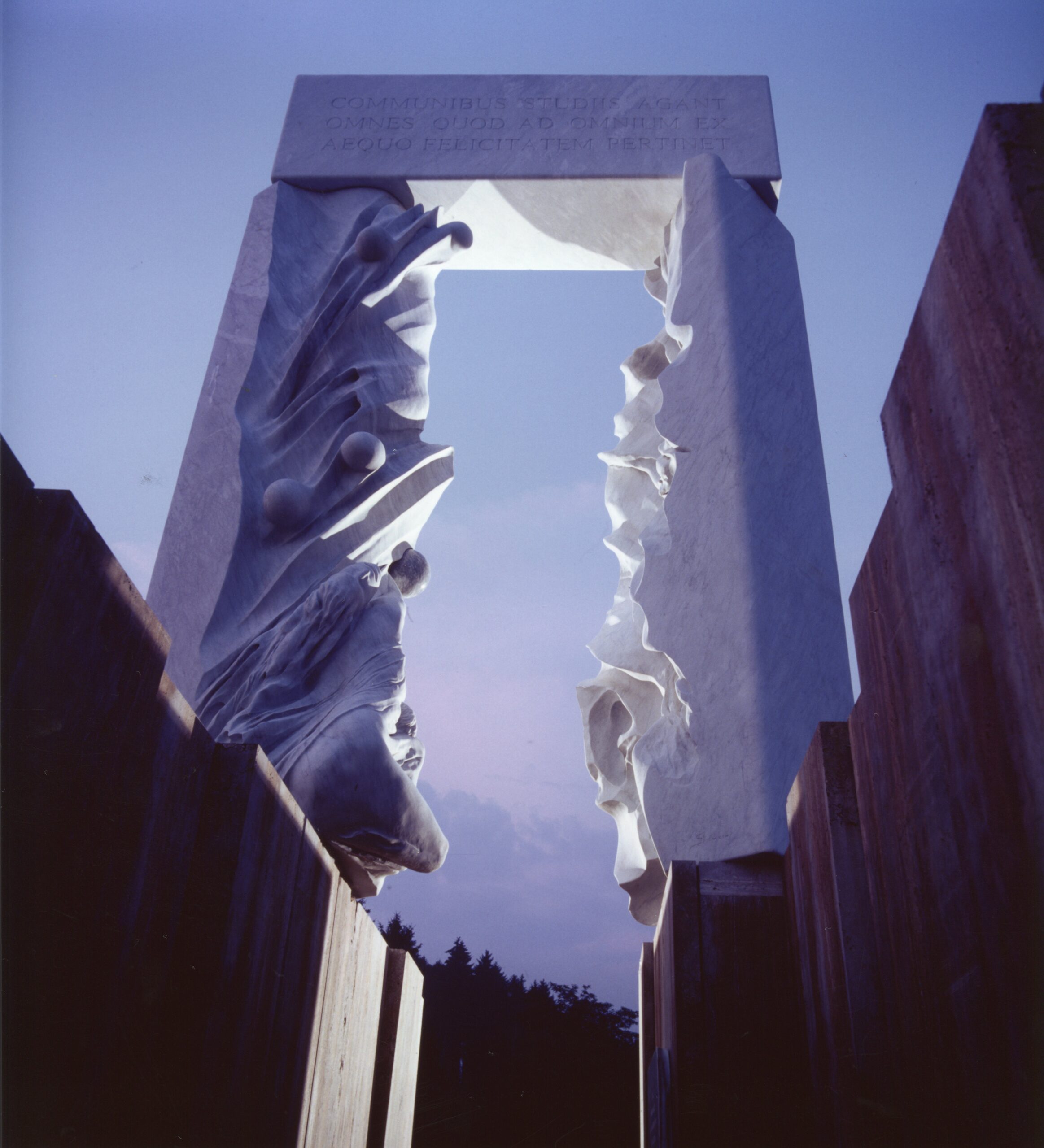
Palazzo Reale, Milano
The exhibition “Somaini e Milano”, promoted by Comune di Milano | Cultura, Palazzo Reale, Museo del Novecento e
Fondazione Somaini, retraces the work of the great internationally known Lombard sculptor, from his student years to his final phase. The exhibition, which is curated by Fulvio Irace, Luisa Somaini and Francesco Tedeschi on project of Enrico Crispolti, is set up in three venues, Museo del Novecento, Royal Palace of Milan and Fondazione Somaini, explores the different areas of his diverse and creative research, thus bringing to light his collaboration with the leading Milanese cultural players at that time. The project originates from a systematic study of the artist’s workshop, during the publication of “Catalogo ragionato della scultura’’ edited by Enrico Crispolti and Luisa Somaini, published in 2021.
In front of the Royal Palace the installation “The Developement of a anthropomorphic work” (1979) is a great signal of the exhibition.
The exhibition devoted to Francesco Somaini in the halls of Palazzo Reale is an extension of the exhibits housed at the Museo del Novecento and in the headquarters of the Foundation dedicated to the sculptor, respectively. It
is an exhibition aimed at outlining the diverse facets that distinguished the relationship between the sculptor’s
artistic career and the city of Milan. The path of the exhibition focusing on Somaini’s sculpture begins with a series of maquettes produced during the conception phases of the project for the Monument to Italian Seafarers, created between 1966 and 1967, and continues with a selection of works that played an important role in Somaini’s poetics, on display in the Lanterna Hall and Cariatidi Hall, respectively. The works shown in the Lanterna Hall testify to Somaini’s figurative debut and his development toward abstraction, initially exploring “Plastic Expressionism” and then moving on to a “Synthetic Cubism”, ultimately reaching a further formal and dynamic synthesis, which can be set in the context of a European concrete abstractionism, between 1956 and 1957. The works on display in the Cariatidi Hall represent the heart of the artist’s poetics, namely his “Informalist” season that marked his production between 1958 and 1964, in which attention was paid to the exploration of free and dynamic forms, whose internal motion, the processing of materials, and the inclusion of light underpin the study of the “fragment” and the aspiration to a “monumental” dimension. These investigations will be then enriched with a study of the relationships with the surrounding environment both at the level of urban architecture and of the natural landscape. Beginning in the seventies, initially with Carnified Architectures and then with Traces, Somaini introduced a dialogue between a sort of metamorphism, which blended with a recovery of anthropomorphism, and the rigid structures characterising the modern era. It is precisely his leaning toward creating an active form in sculpture that translated into a physical presence of strongly vital forms.
Exhibition project: Studio NUMERO 10 ARCHITETTI
Opening hours
Tuesday, Wednesday, Friday, Saturday, Sunday from 10 a.m to 7.30 p.m.
Thursday from 10 a.m. to 10.30 p.m
(last admission ine hour before closing)
Biglietto
Free entry
Entrance for vistitors in piazza Duomo, 12
Sala della Lanterna: Monument to Italian Seafarers
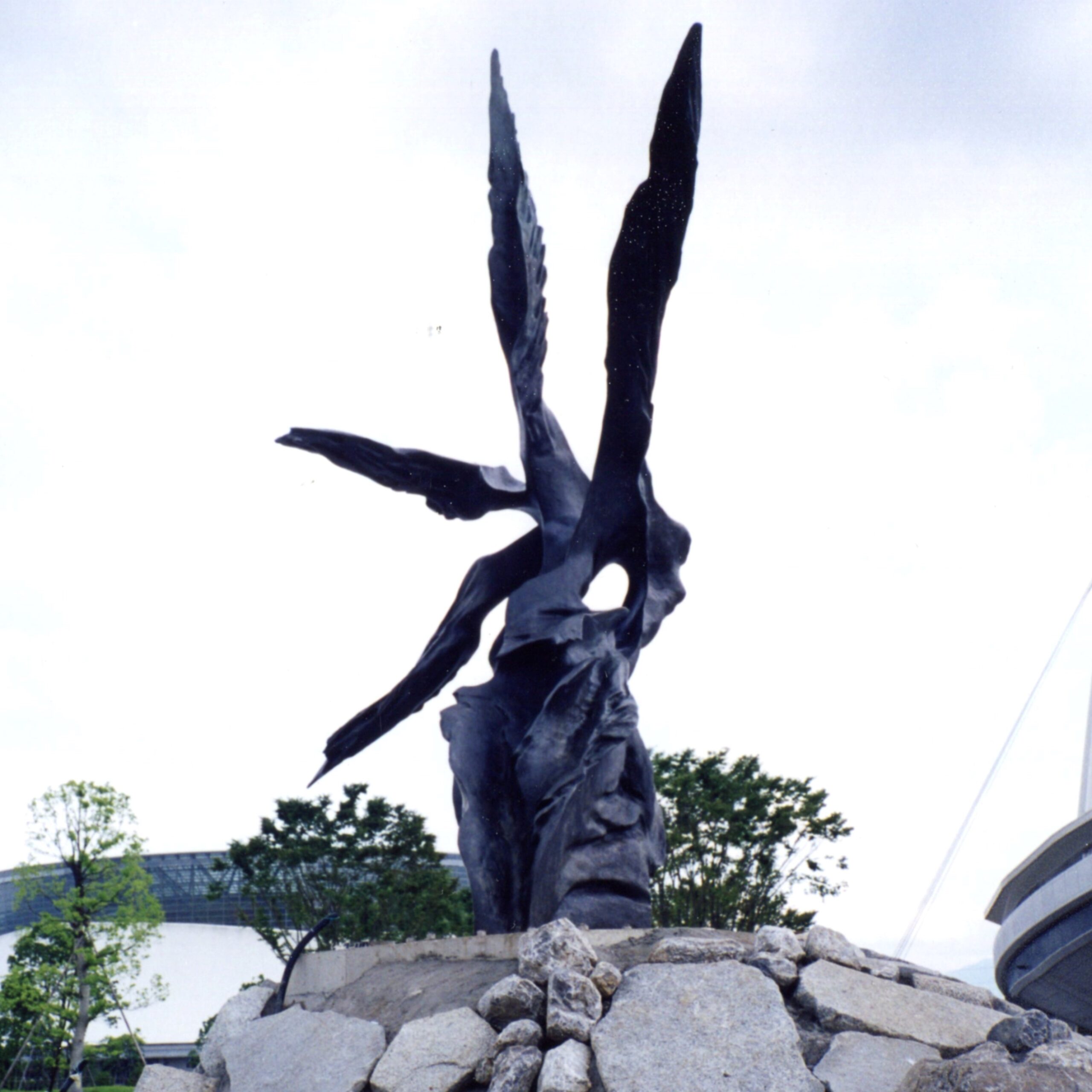
The important commission for the execution of a monumental work to be erected in Milan leads the artist to study the motif in a series of preparatory sketches, in which he partially takes up the theme of Tales on the sea, superimposing it on that of the winged Victory, with reference to the famous masterpiece of the Nike of Samothrace. Motifs previously explored in some sheets of the Metamorphoses. Somaini makes several sketches in plaster or resin, in some cases shot with sand, from which the preparatory model for the large sculpture to be placed on the fountain in Largo Marinai d’Italia is chosen. On February 8, 1967 he presented to the authorities the series of sketches as part of an exhibition set up in his atelier in Lomazzo, alongside the plaster enlargement of the chosen model in 1: 1 scale, partially patinated bronze. On this occasion, the artist does not exhibit the specimens entitled The two flags, a variant of which contains the allusion to an overturned skull, a symbol of the cost of human life incurred by the city. Among those exhibited is the Winged Monument, proposed in the competition held in 1968 by the National Arma Aeronautica of Gallarate and preserved there. Some of the sketches exhibited in Lomazzo, on the other hand, do not come to fusion. One of these, mounted on a high pillar, anticipates the next series of the Triumphs. Some bronze specimens, donated to the President of the Republic Giuseppe Saragat and the Mayor of Milan Pietro Bucalossi, are now preserved in the collections of the Quirinale and Palazzo Morando, formerly the Museum of Milan (tthis is now visible in the section of the exhibition at the Museo del Novecento). The experience gained in the creation of the Milanese monument led the artist in the following years to start variants of the motif in the great Phoenix in Atlanta (originally located in front of the headquarters of the First National Bank), one of the three monumental works erected in the United States in 1970, and later in the Great Winged Sculpture erected near the Kumamoto stadium in Japan.
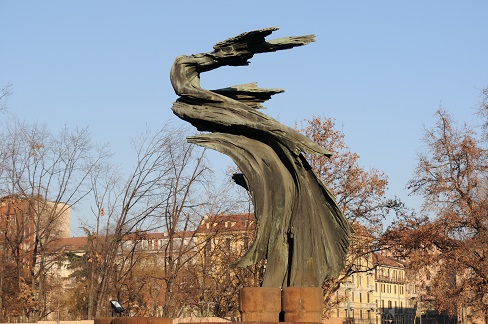
Monument to Italian Seafarers, 1967
Milano, Largo Marinai d’Italia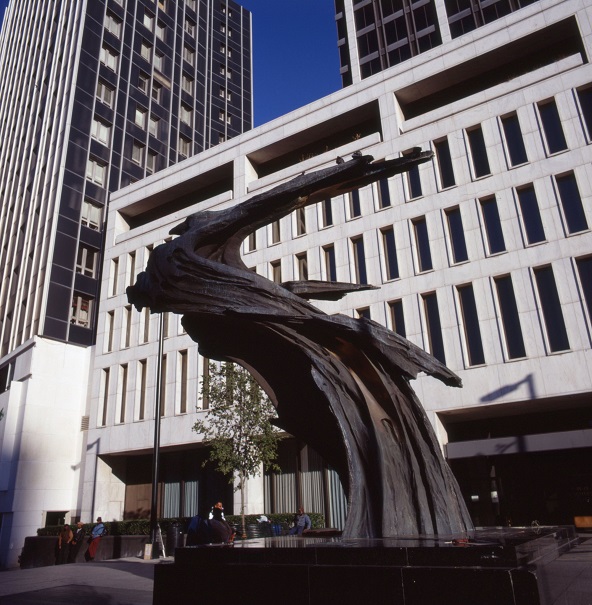
Phoenix, 1968-70
Atlanta, Broad Street Plaza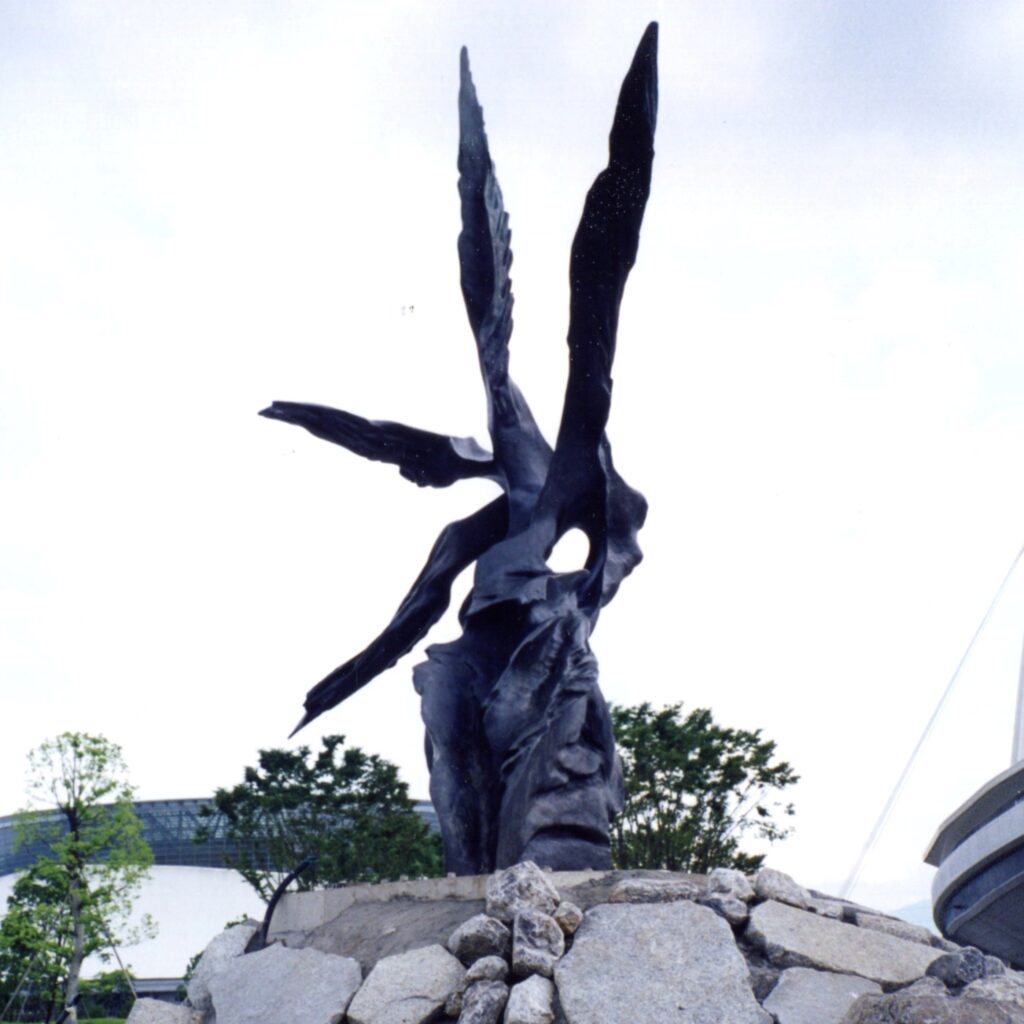
Great winged Sculpture, 1998
Kumamoto, Symbol Plaza
Sala del Piccolo Lucernario: from figure to post cubism and concretism
This room exemplifies the figurative beginnings and the developments towards forms of abstraction that pass from the experiences of a “plastic expressionism” to that of a “synthetic cubism”, reaching a further formal and dynamic synthesis, which is part of the concrete European abstract art, between 1956 and 1957.
Somaini devoted himself to sculpture at the age of ten. During his high school years he frequented Franco Ciliberti (1905-1946), close to the Como abstractionists and author of the synoptic table I creatori. Perspectives on the spiritual becoming of all peoples and all times. Philosophy, Religion, Literature, Arts (Milan 1932), as well as director of the magazine and of the group “Primordial Values” of 1938. Primordial Portrait or Primordial Head or [Homage to Franco Ciliberti], executed a few years after his death is dedicated to him. After returning to Italy from Switzerland, where he met Meret Oppenheim who introduced him to the fundamentals of Surrealism, he trained at the Brera Academy with Giacomo Manzù and joined the “Arco Group” (later “del Cerchio”), collaborating with the magazine “Sentimento” (1946). He made his national debut at the Rome Quadriennale in 1948 with a bas-relief and exhibited Bather (1948-49) at the 1950 Venice Biennale. He then started a profound reflection on contemporary sculpture from beyond the Alps and in 1950 he built his atelier in Lomazzo. The following year he made his first study trip to Paris, where he met André Bloc and Léon Degand. In 1952 he participated in the competition for the Monument to the Unknown Political Prisoner to be erected on the cliffs of Dover (Olivetti Prize). At the same time he frequented the Como abstractionists and began collaborating with Ico Parisi, working under the banner of “integration of the arts.” He exhibits Dancer at the Rome Quadriennale of 1951-1952 (Villa Bini in Monte Olimpino) and performs Great Motif for the Living Pavilion, erected on the occasion of the 10th Milan Triennale in 1954, which obtains the gold medal. In the same year he exhibited Macabre Motif at the Premier salon de la sculpture abstraite at the Galerie Denise René in Paris and participated in the Venice Biennale with the Grand Warrior in concrete. He began his collaboration with the architect Luigi Caccia Dominioni, too.
In 1955 he participated in the exhibitions of the Groupe Espace and joined the MAC-Espace. Carlo Ludovico Ragghianti invited him to the “Exhibition of 60 masters of the next thirty years” in Prato. The following year he exhibited at the Venice Biennale The Force of Birth and Open Song in ferric conglomerate (material he invented), gaining the attention of international critics, and held his first solo show at the Strozzina in Florence. He met Enrico Crispolti who presented him in the personal exhibition at the La Salita Gallery in Rome in 1957. In the same year he exhibited at the “International Sculpture Prize of the City of Carrara” and at the traveling group show “Italian sculpture of the twentieth century”. He was one of the organizers of the review “Colors and shapes in the house of today” in Villa Olmo (Como), where he exhibited paintings and sculptures, and was active in the house of Ico Parisi with Lucio Fontana and Fausto Melotti.
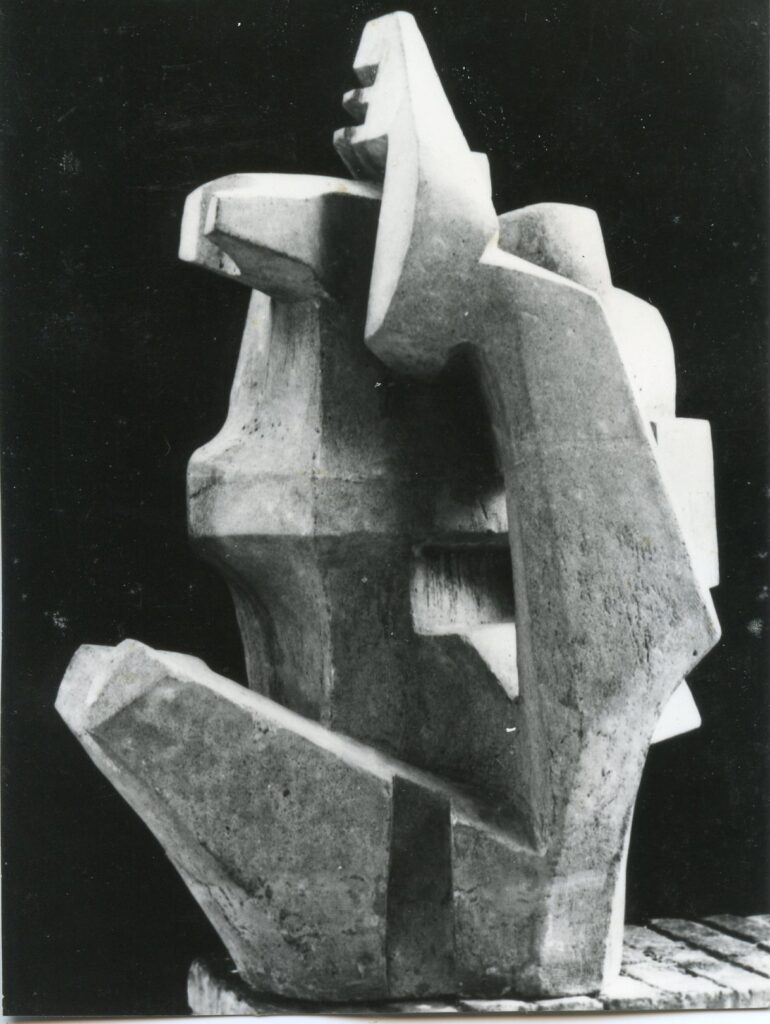
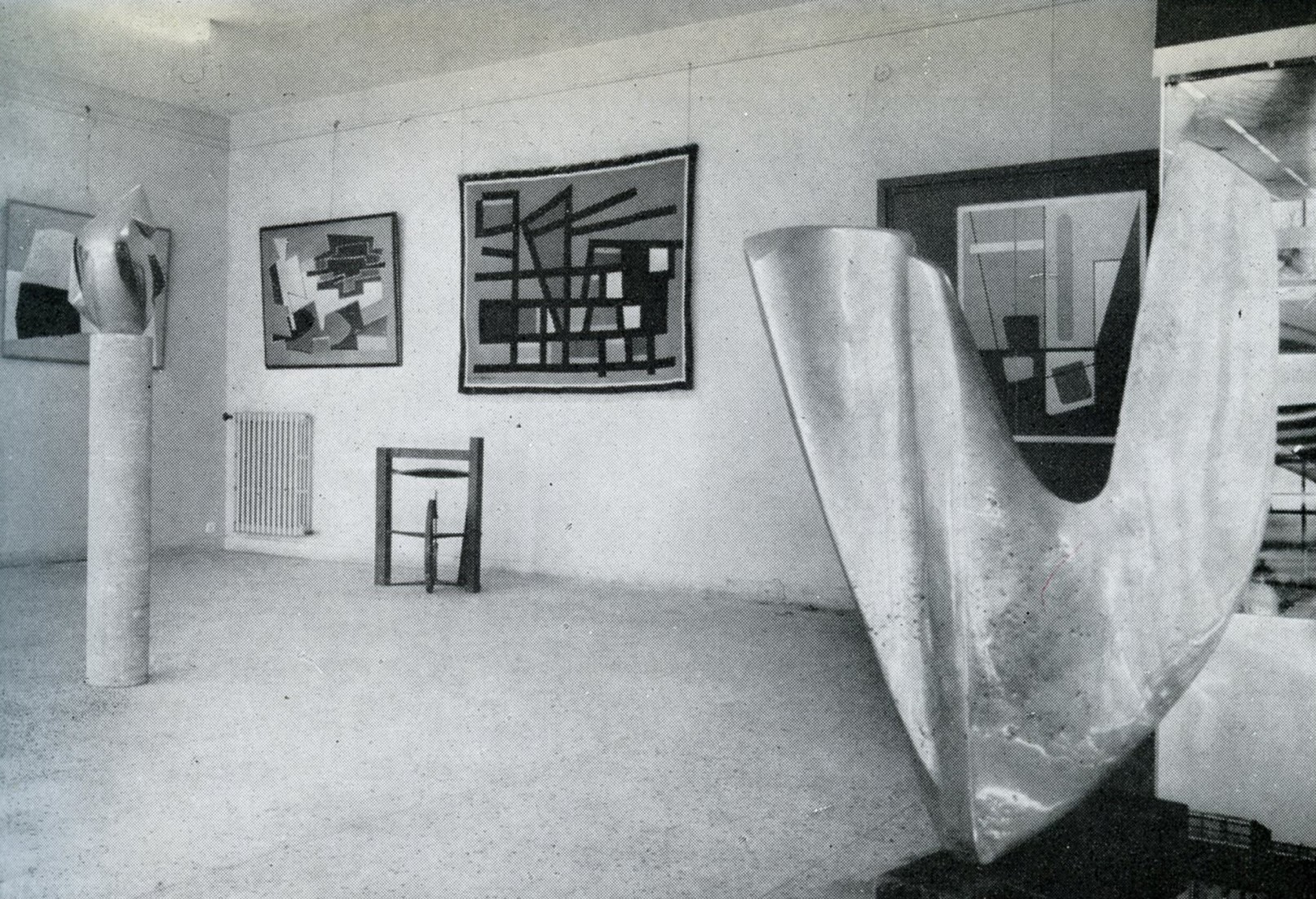
The Grand Warrior (1953) at the Venice Biennale in 1954. 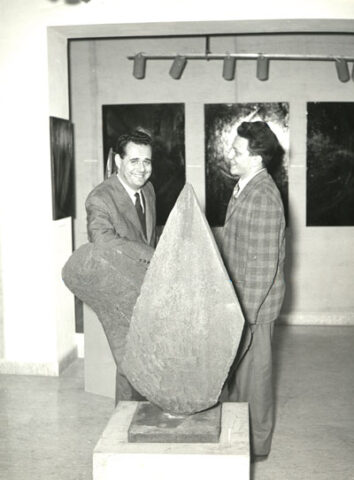
Somaini and Crispolti at La Salita (Rome) in 1957. In the foreground: Conquered Impenetrability (1956) in ferric conglomerate. 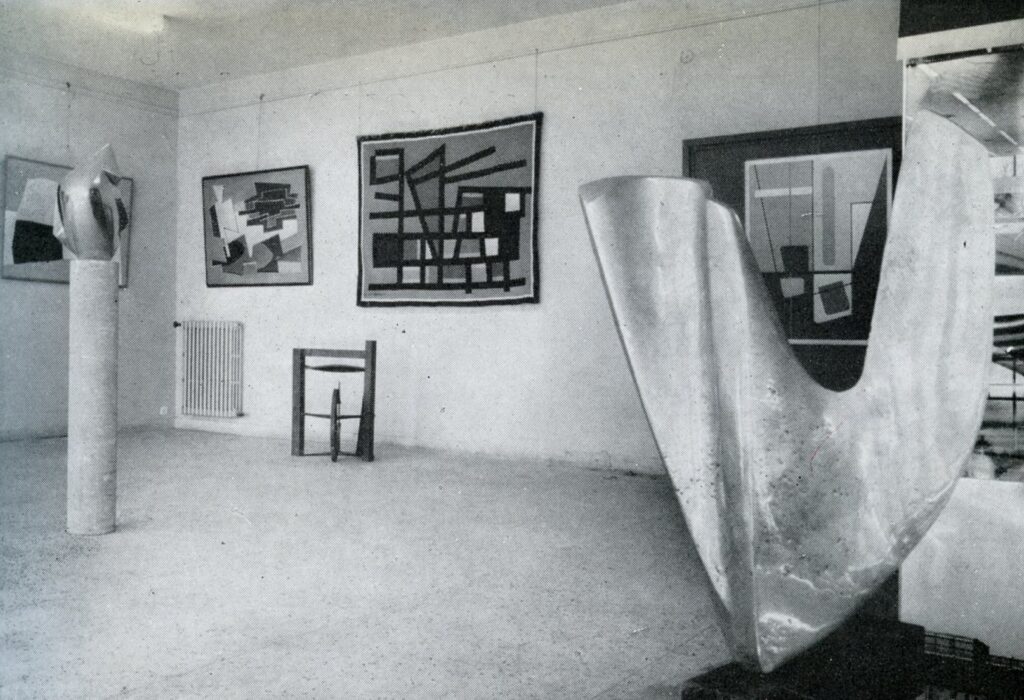
Exposition itinérante. Architecture contemporaine. Intégration des arts, Casablanca in 1957. In the foreground: Absolute Is a Movement or Absolute I (1956).
Sala delle Cariatidi: Informal, Carnified Architectures, Antropoammoniti, matrices and traces
The works presented in the Sala delle Cariatidi constitute the fulcrum of the artist’s poetics, through the examples of the “informal” season, which characterized his work between 1958 and 1964 approximately. To these will be added the relationships established with an environmental connotation, both in terms of urban architecture and in the comparison with the natural dimension through the Carnified Architectures and the Antropoammoniti, matrices and traces.
In 1958 he exhibited at the Venice Biennale, the following year at the São Paulo Bienniale in Brazil, where he obtained the prize for best foreign sculptor, which opened the market for him in the USA. In 1960 he held a solo show at the Italian Cultural Institute in New York, promoted by the Odyssia Gallery that follows his work, presented by Giulio Carlo Argan. On the occasion of the hall at the 1960 Venice Biennale he published a monograph with texts by Michel Tapié and Umbro Apollonio. The following year he participated in the II Biennale de Paris where he received the French Critics Award. He exhibited his informal sculptures (which he organized in the series of Verticali, Orizzontali, Oblique, Martìri, Feriti, Tales and Figures of Fire) in numerous solo shows and in the most important exhibitions in Italy, Europe and the USA.
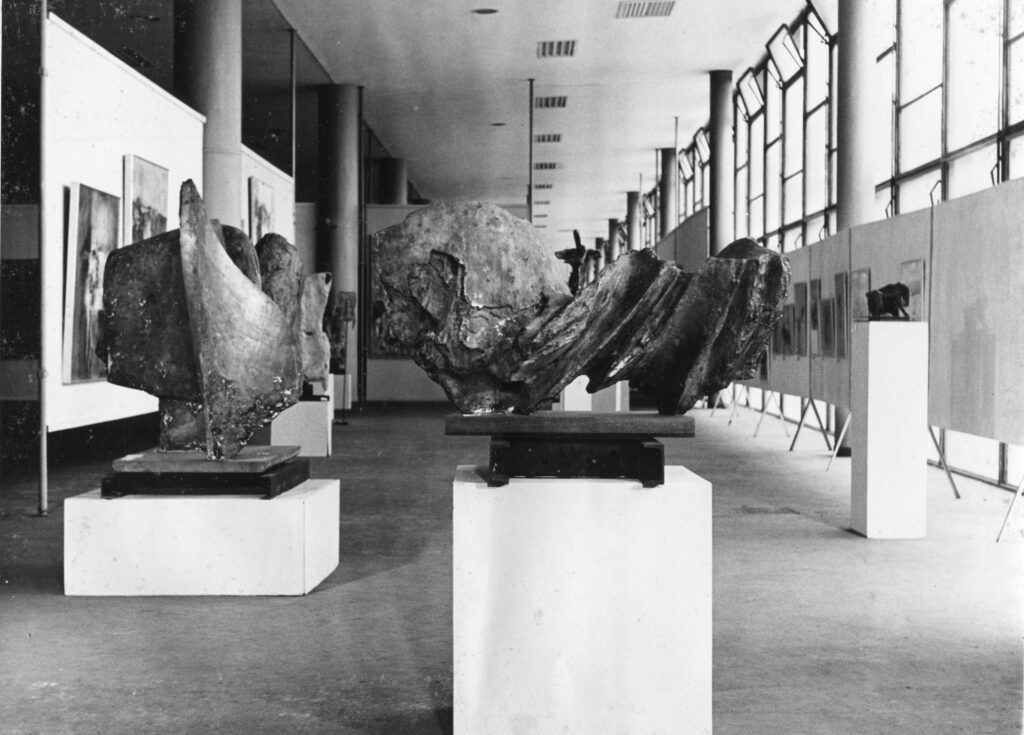
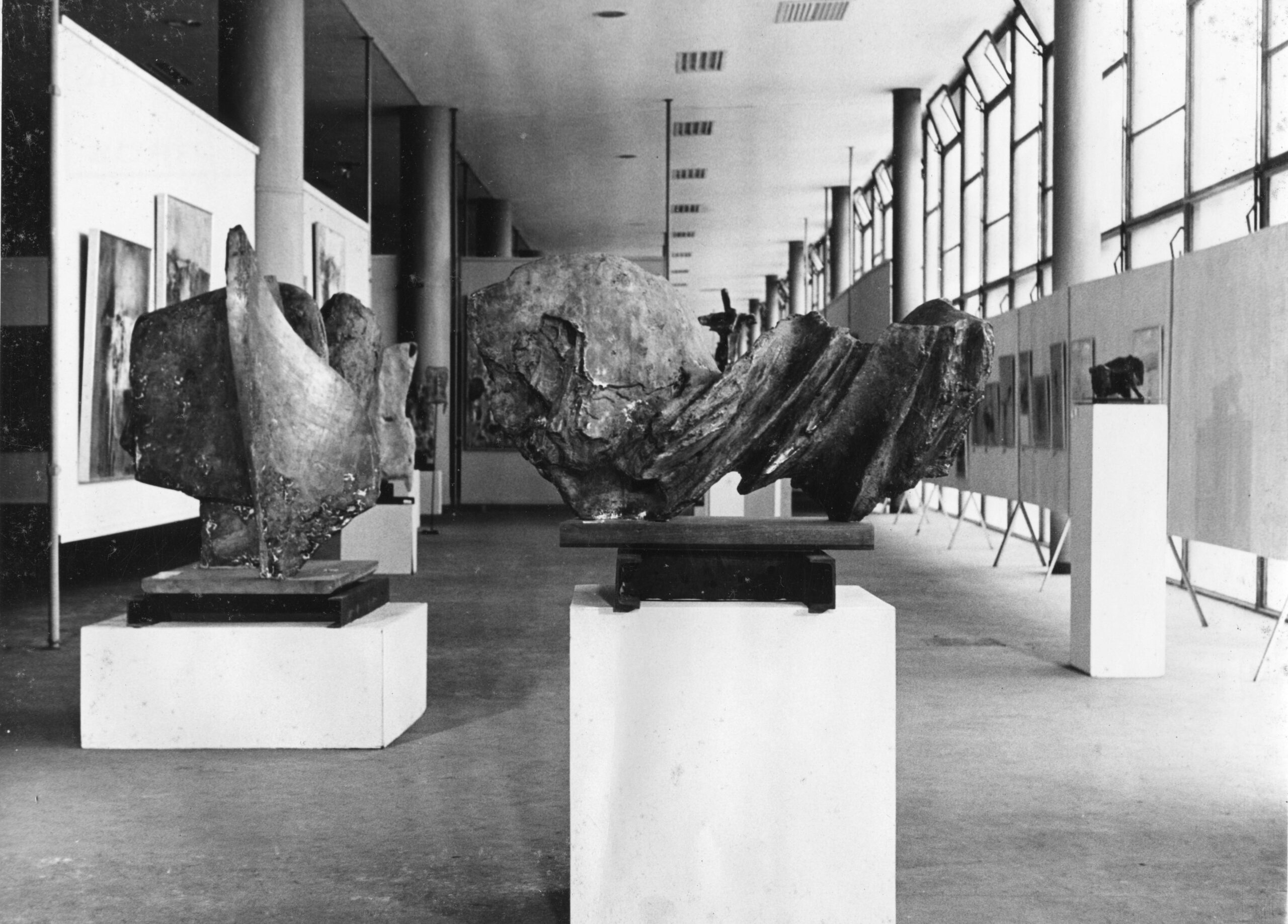
Some Somaini’s sculptures at São Paulo Bienniale in Brazil in 1959. In the foreground: Grand Horizontal II (1959). To the left: The Grand Affirmation (1958). 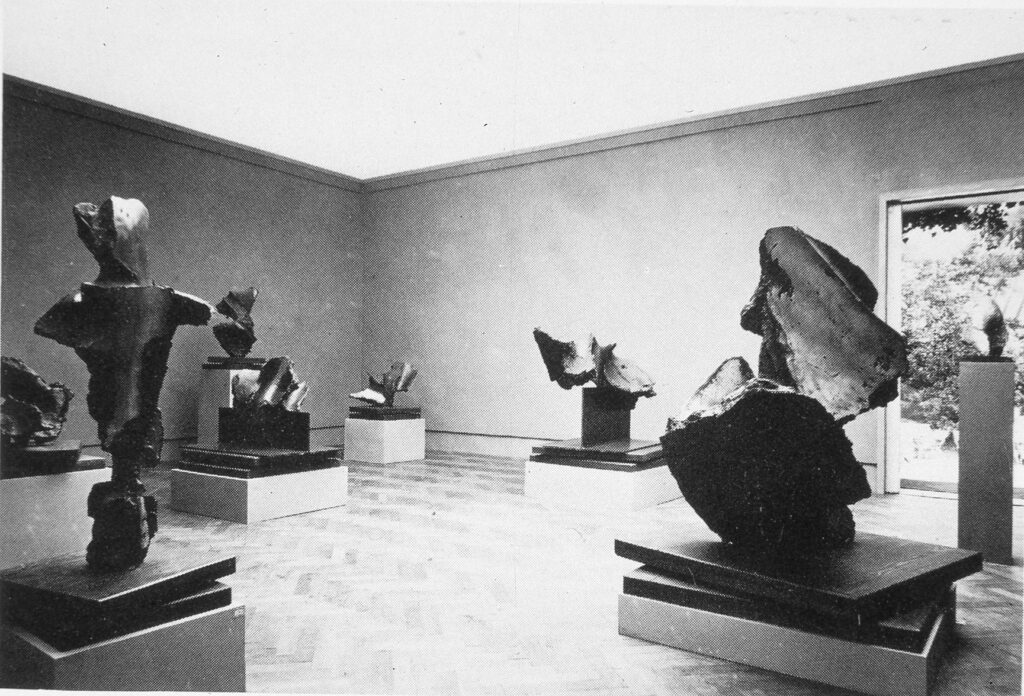
Somaini’s hall at the XXX Venice Biennale in 1960. In the foreground: Large Bleeding Martyrdom (1960) and Large
Navigator. Internal Large (1959).
Since the end of the 1960s, the environmental vocation of his work found a way to express itself in some projects of public interventions in the United States (with large-format sculptures of different types inserted in the urban fabric of Atlanta, Baltimore, Rochester) and in Italy, also for ecclesiastical commissions (church of Santo Spirito in Bergamo). His sculpture was taking on dramatic features, in the configurations of anthropomorphic ancestry, which related to the architectural modules, to deny their rationality. From this season comes the series of drawings and reflections for the volume created with Enrico Crispolti Urban Urgencies (Mazzotta, Milan, 1972), a turning point for a different kind of environmental connotation, including participation in the Volterra 73 and Operazione Arcevia initiatives (1975-1976), proposals for urban reconfiguration, is a first consequence. From these premises was born the series of “Carnifications of an architecture” (1974-78), sculptures inspired by the comparison with the structures of the modern city, of which New York is the model, and the photomontages of utopian setting that make them explicit.
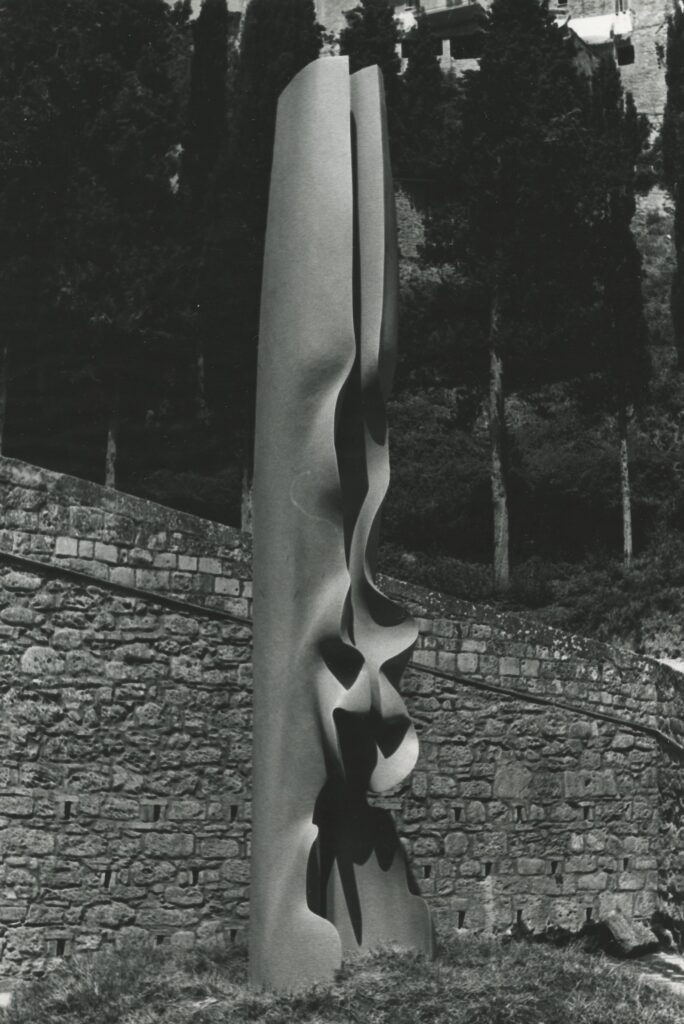
Large
Saturnine Flesh (1969-73) in pink-painted resin at Volterra ’73.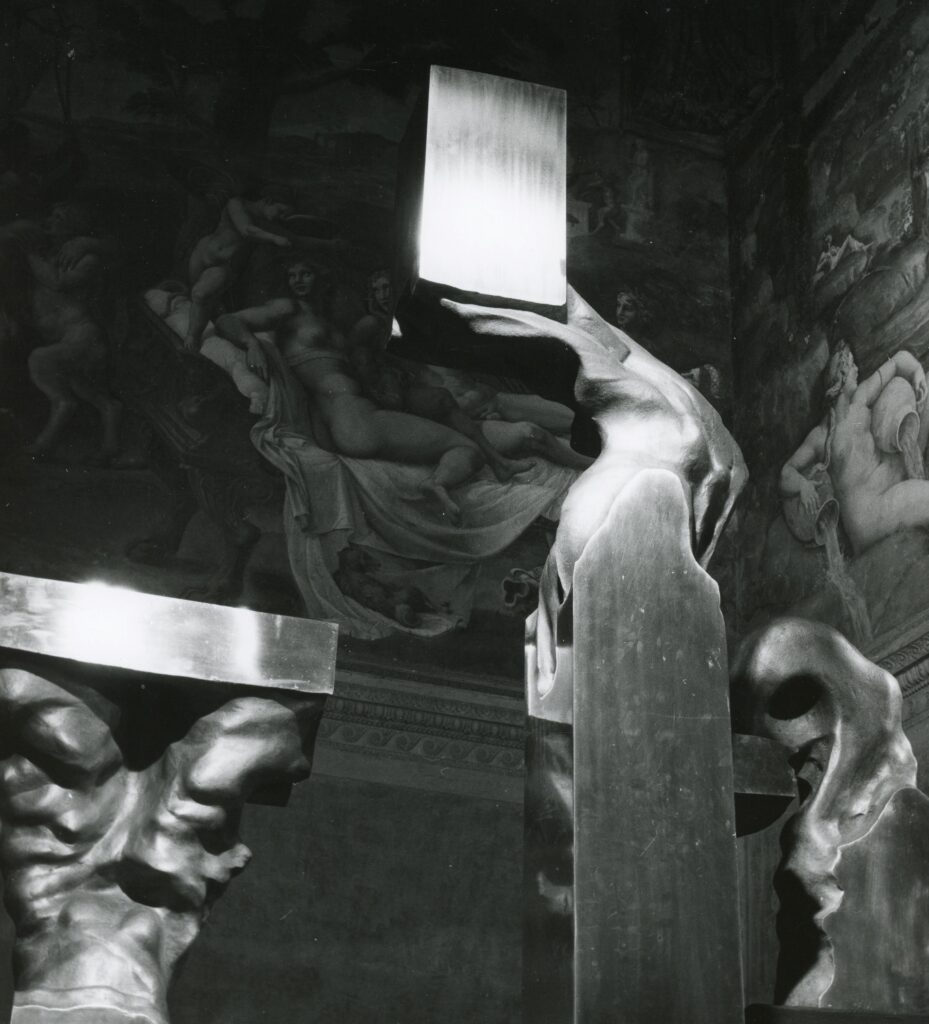
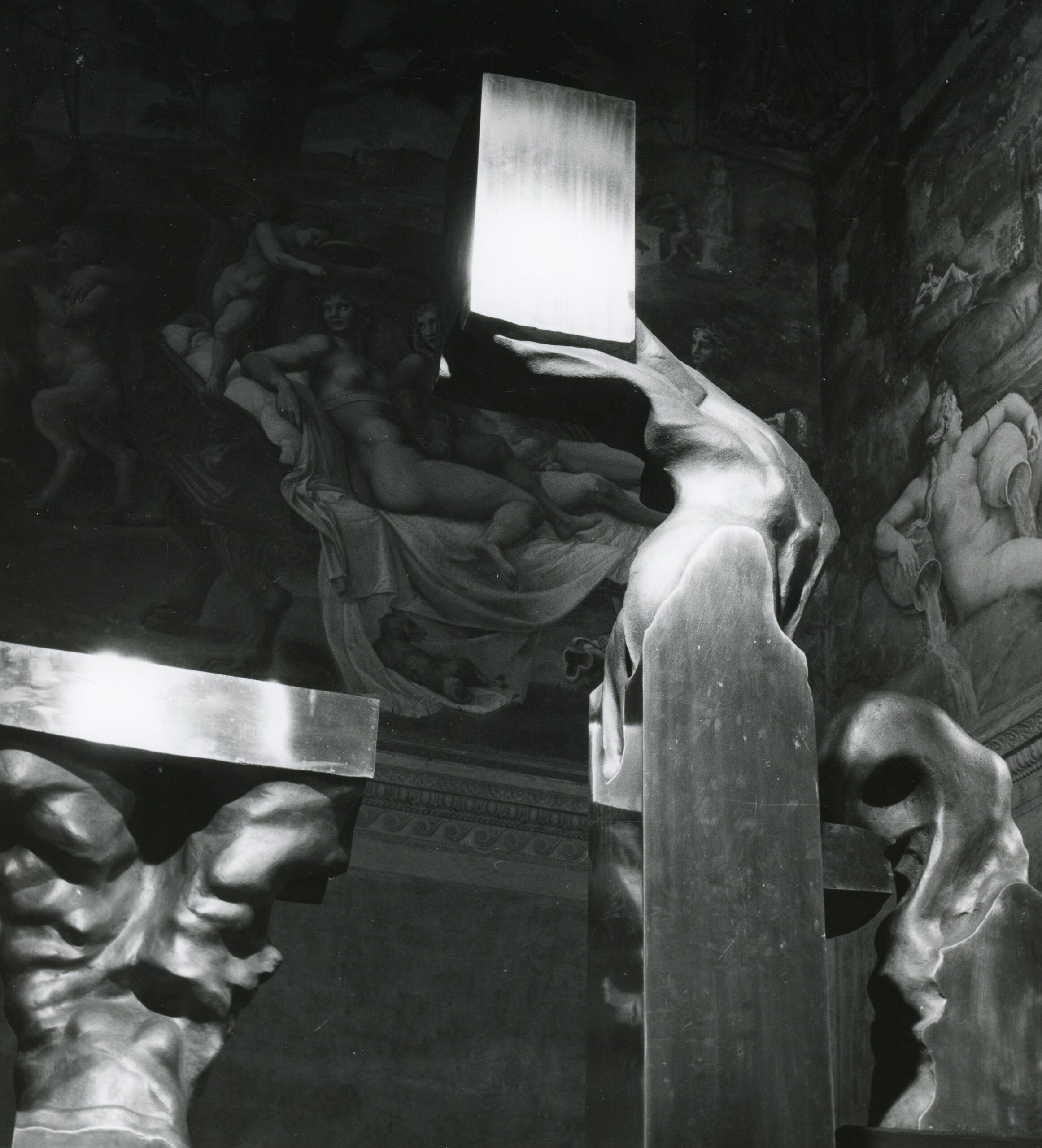
Some Somaini’s sculptures in Palazzo Te in Mantua in 1977. From the left: Carnified Architecture: Martyrdom I (1975), Colossus of New York II (1976) and Carnified Architecture: In Vinculis (1975). 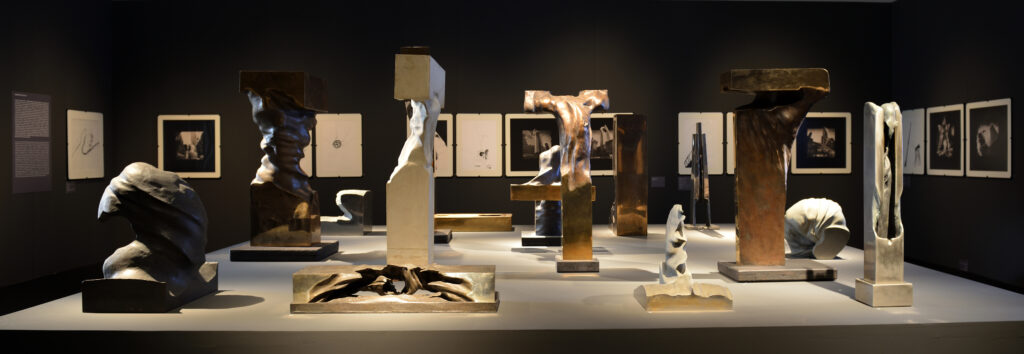
Some Carnified architectures in the setting up of the exhibition Francesco Somaini . Uno scultore per la città. New York 1967-1976 at Triennale in Milan in 2017.
In the second half of the 70s, in the wake of relentless exploration of the transformation of the plastic
form into a representative synthesis, Somaini focused on the Antropoammoniti cycle to express a recovery of
the organic dimension, which will supersede the forms of mechanical rationality. In this framework, he also
retrieved marble processing, besides relying on resins thanks to their plastic ductility. Sculpture was therefore
conceived as an active form, the result of internal turmoil, but also adaptable to a physical action exerted on
the exterior, through the configuration of ‘traces’ ( tracce ) produced by plastic bodies, in the pursuit of a
relationship between matrix and print. By referring to anthropomorphism, the sense of myth emerged , evoked
by the processes employed and the form yielded, which stemmed from the combination of the materials used
and the action of transformation dictated by the artist who, relying on his ‘workshop techniques’ (e.g., the
processing of volumes and surfaces with high pressure sandblasting, which Somaini began experimenting with
in the mid seventies), is the creator of a metamorphosis of matter and image.
During these years, several monumental works created by Somaini were installed in Italy and Japan
His works were displayed at several solo shows (for instance, his personal hall at the 1978 Venice Art Biennale)
and retrospective exhibitions (Duisburg, 1979; Rotonda in Via Besana, Milan, 1990; Palazzo di Brera, Milan,
1997; Pergine Valsugana, 2000).
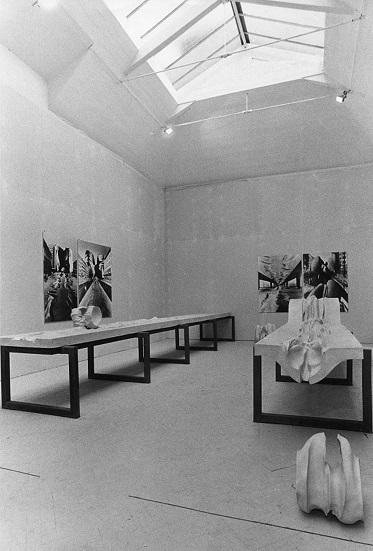
Somaini’s hall at Venice Biennale in 1978. In the foreground: Antropoammonite XVI. La Grande Aggressiva (1977-78). To the left: Grande Traccia e Piccola Antropoammonite XV (1977), Prima Traccia e Piccola Antropoammonite XVI (1977). On background: photomontages for the
Counterproject for Königstrasse in Duisburg (1978).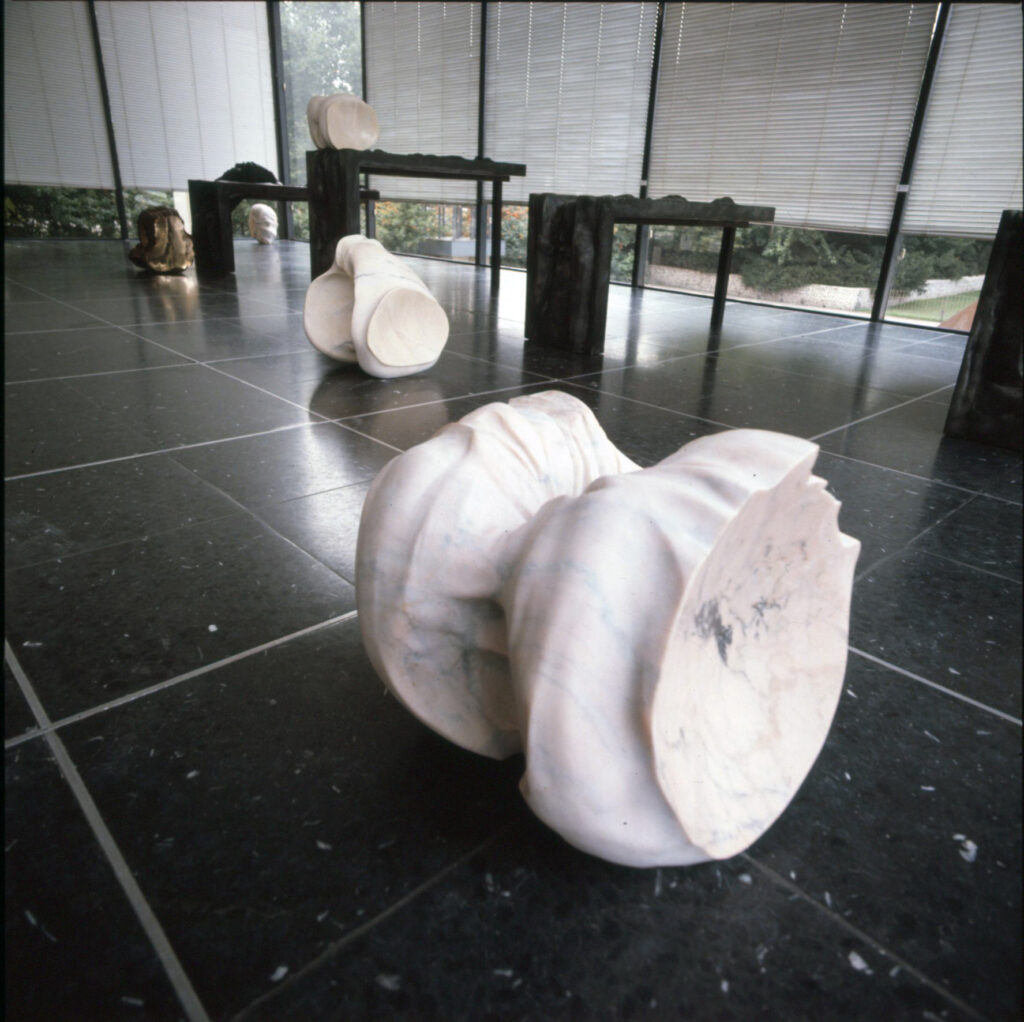
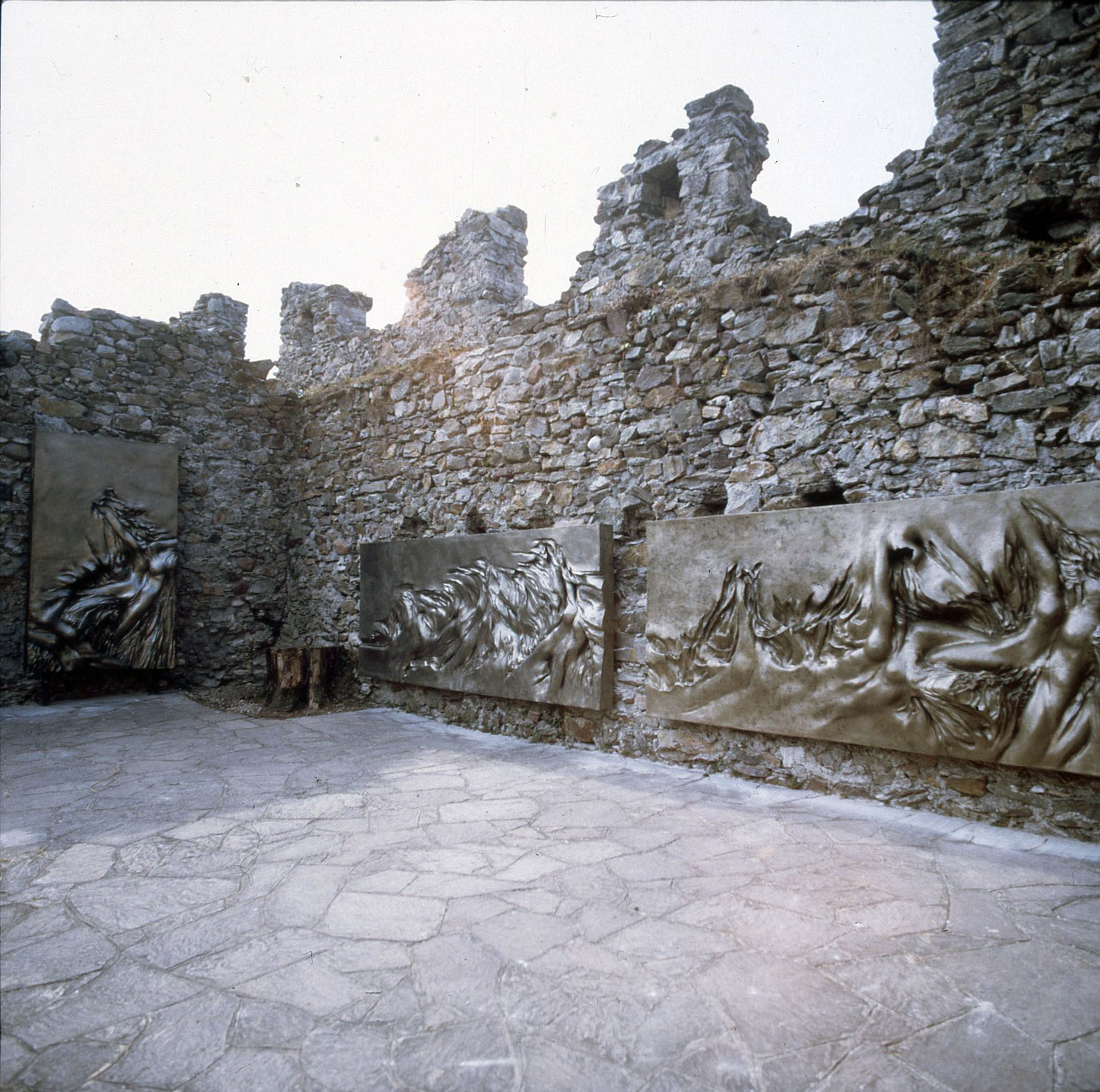
Some marble matrices and resin traces in Somaini’s personal exhibition at Wilhelm Lehmbruck Museum, Duisburg in 1979. 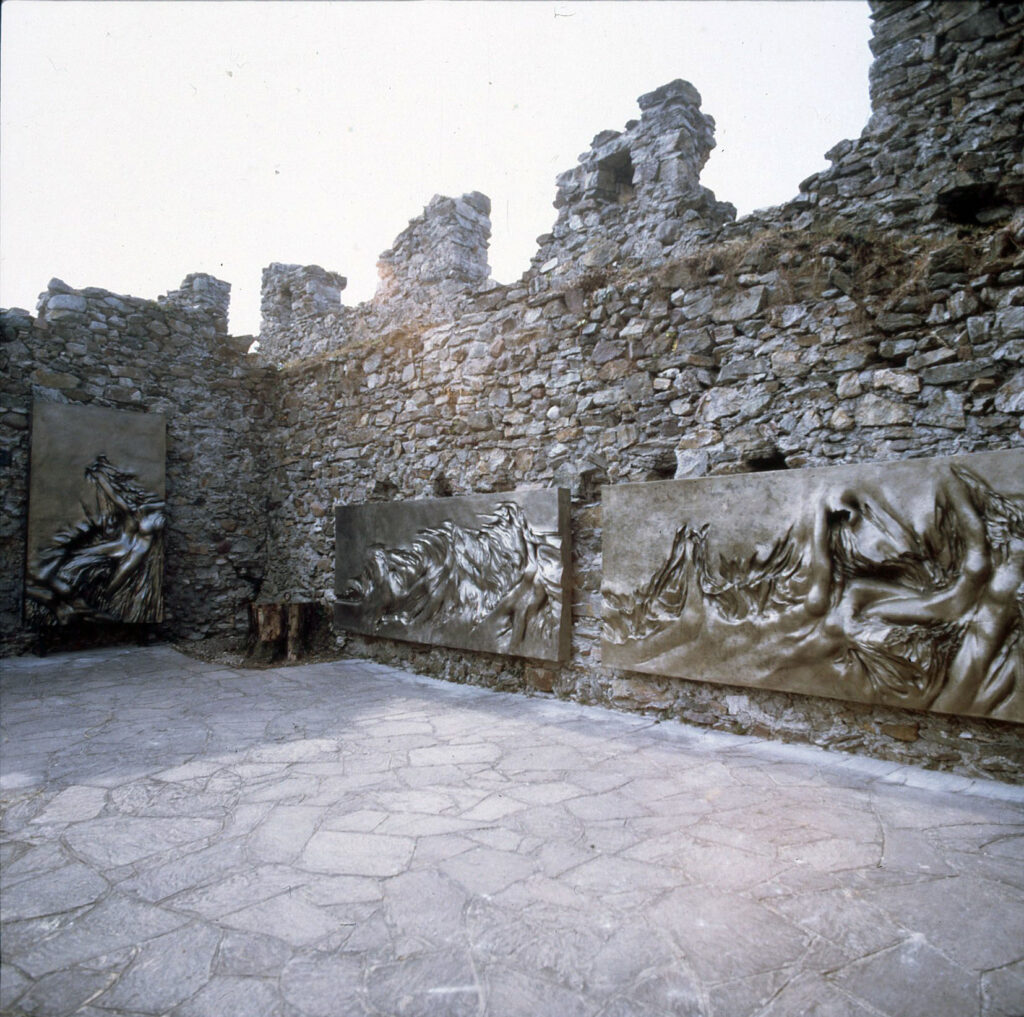
Three large traces on the theme of the Birth of Venus exhibited at Castello di Pergine Vasugana in 2000.
“Fuorimostra”
The exhibition is completed by an itinerary that takes us beyond the exhibition venues to visit monumental works
created by the sculptor in the Lombard capital, where he trained, lived, and worked for many years, as well as some neighboring cities: Bergamo, Como and Monza, and even small towns, like Lomazzo, his birthplace, Cernobbio, Menaggio, Viggiù, and Voghera. These works, taken together, enable us to recapitulate the achievement of over almost half a century by the artist, accustomed to “work on the large scale”, with the conviction that “the only future left to sculpture is the urban and social field, and the measure and the modes that follow from this.” (Francesco Somaini, Observations on sculptures, 1974, manuscript, Archivio Francesco Somaini). Among his many works in the field of sculpture (from the Monument to Italian Seafarers in Milan, to the Gateway to Europe at Montano Lucino), the arts applied to architecture with floor mosaics, stained glass windows, and design, created in collaboration with
Ico Parisi and Luigi Caccia Dominioni, we can make out two paths, distinct and parallel, one of an existential and religious nature, linked to the recovery of the symbol of the cross (from the Croce in the Monumental Cemetery of Como, to the Carnified Architecture: Great Martyrdom in Monza Cemetery), the other civil and urban, with the experiences mentioned above. Other unmissable examples of Somaini’s production are preserved in museums
and institutions such as the Museo del Novecento and the Triennale Design Museum in Milan and the MA*GA at Gallarate.
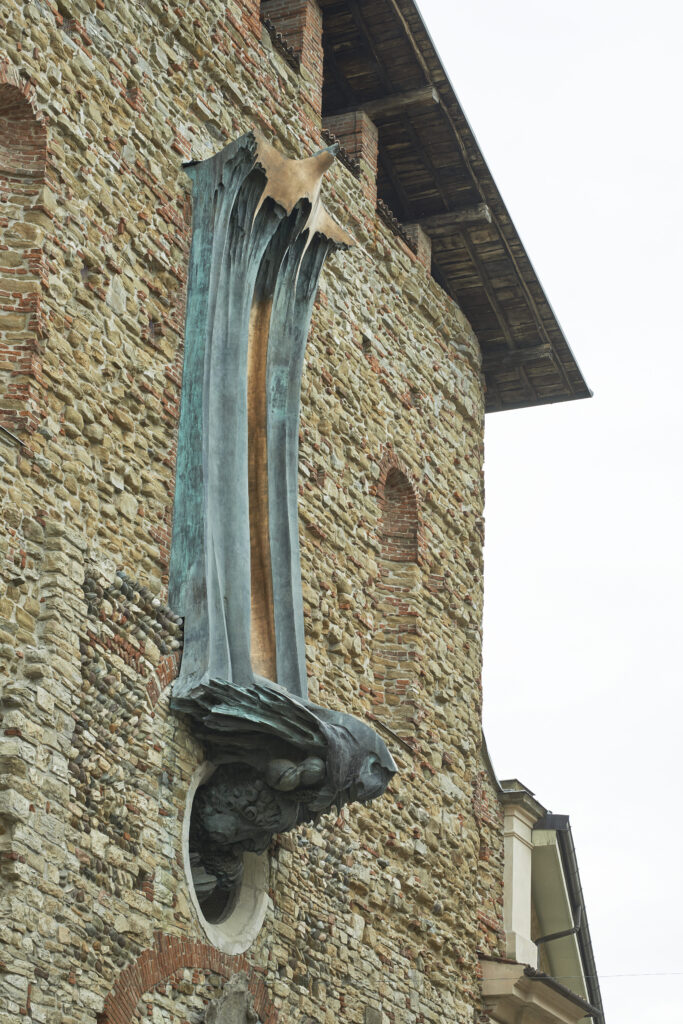
Descent of the Holy Spirit, 1969-72
Bergamo, chiesa di Santo Spirito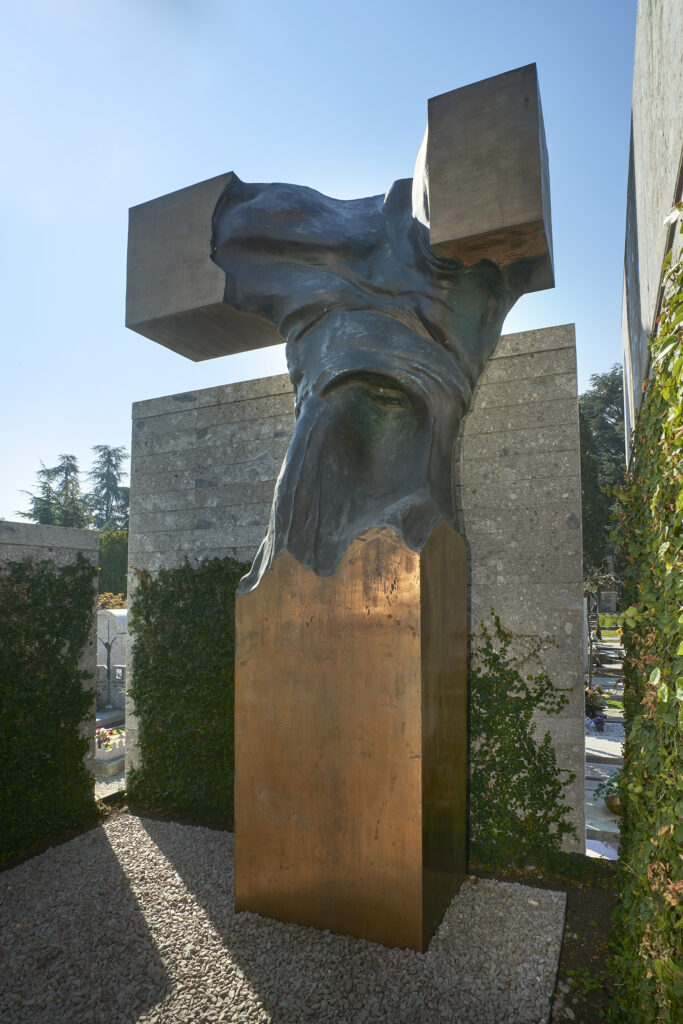
Carnified Architecture: Great Martyrdom, 1974-78
Monza, cimitero urbano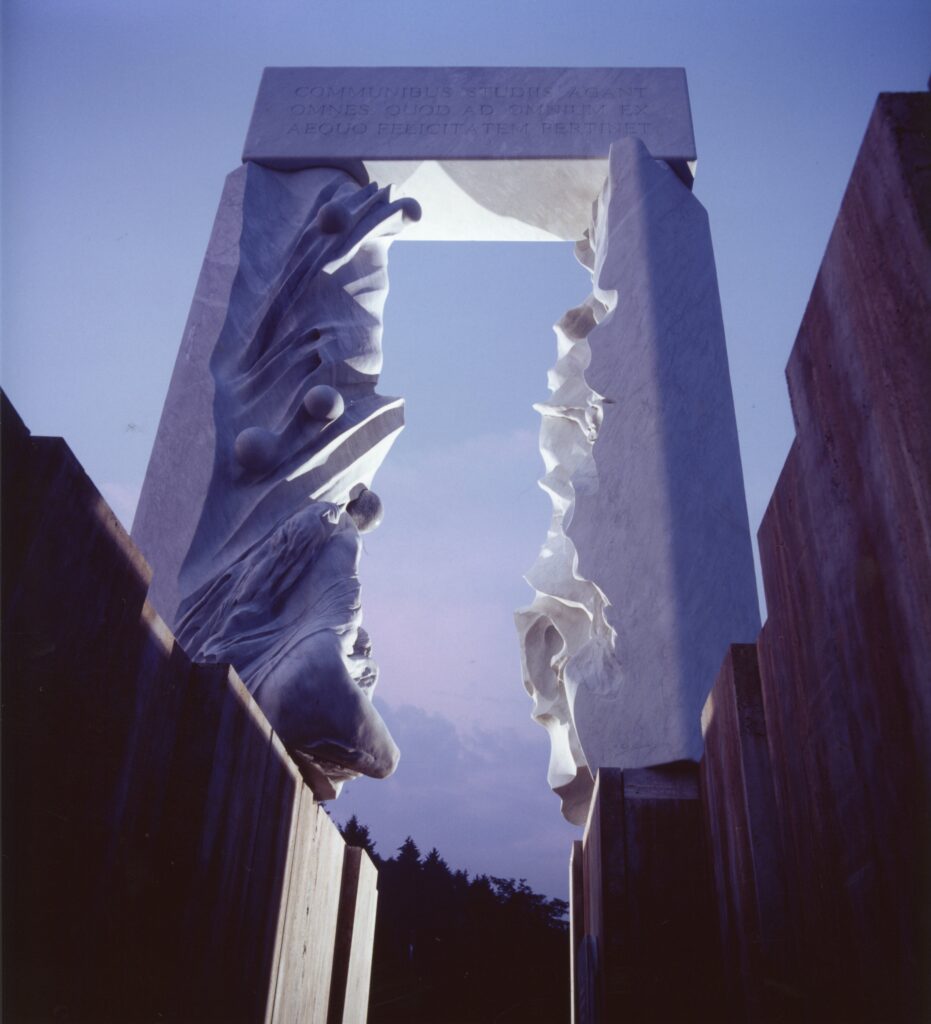
Gateway to Europe, 1992-95
Montano Lucino (Como), centro commerciale Bennet