

Online catalogue raisonné of chalcographic works

The artist’s experimental technique, which in the original Indian ink drawing involved burning the edges of the paper, is highlighted in this print, maintaining the irregularity of the image’s margins within the plate’s margin, more or less chromatically emphasized.
The catalogue raisonné of the sculptor’s engravings will soon be available online. It is compiled based on a systematic cataloguing of the sculptor’s engravings, conducted by Luisa Somaini and Chiara Rampoldi, who worked with archive material, which includes copies of every edition, photographs, and documents.
This is a new chapter in the entire online catalog raisonné, an editorial project launched on the centenary of Francesco Somaini’s birth. It covers his entire oeuvre on paper, divided into drawings, engravings, and photographs.
The artist’s engravings are numerically very small compared to his drawings: Somaini, in fact, usually committed variations on the development of the same motif to paper, collected in small series of drawings, sometimes even numbered sequentially. His etchings, lithographs, and silkscreens are always based on autograph drawings, created at different stages of his creative career, from his formative years to his Concretist and Informal periods, up to his reflections on the relationship between sculpture, architecture, and the urban context.
To emphasize this close relationship between graphic art and copperplate engraving, the artist sometimes adds a double date, considering on one hand the year the drawing was made, on the other the year of the edition. See, in this regard, the prints titled Cranio di cavallo (Horse Skull) (1948-51), printed by Aldo Galli in just three copies, distinguished by varying degrees of inking, and Croce stendardo (Standard Cross) (1966-2004).
Drawings were gradually transferred onto the plates by the printers with whom Somaini collaborated over time: from the Como-born sculptor, painter, and engraver Aldo Galli (Como, 1906-Lugano, 1981), a friend of the artist, to the great engraver and printer Giorgio Upiglio (Milan, 1932-2013), the creator of sheets of particularly refined execution, not to mention other companies in the sector, such as Edizioni Seriarte, Bora, and Stamperia d’arte L’incisione.
Among these prints, the etchings and aquatints created by Giorgio Upiglio for the volume of Guido Ballo’s poetry, L’albero poeta, deserve particular attention. The collection includes works by Enrico Baj, Pietro Cascella, Alik Cavaliere, Roberto Crippa, Lucio Fontana, Gastone Novelli, Achille Perilli, Arnaldo Pomodoro, Giò Pomodoro, and Francesco Somaini. The volume was published in 1966 by Galleria Schwarz in Milan, and an example of this work is held in the collections of the Museum of Modern Art in New York (Monroe Wheeler Fund). The printer’s skill is also evident in the refined effects of washed Indian ink, created on paper by Somaini using the aquatint technique. See, in this regard, Albero della Vita (1991), created for the Floriani Foundation for the 1990 Milano Immagine Prize.
Somaini’s engravings are also held in several public and private institutions, both in Italy and abroad, including the Como Municipal Library, the Museum of Modern Art in Bologna, the Galvani High School in Bologna, the Floriani Foundation in Milan, and the Archivio del Moderno in Balerna (Lugano).
The digitized materials, whose inclusion in the online platform was entrusted to Martina Mangia, will soon be available on the Catalogue Raisonné page of this website.
Corpo Urbano: dalla scultura alla città. Scritti polemici (1970-1982)
Edited by Fulvio Irace
Johan & Levi Publisher

This volume collects the principal writings of the sculptor Francesco Somaini (1926-2005), who dedicated one of his most successful creative periods to the theme of the city. A pioneer of urban art in Italy and Europe, Somaini pursued his research beyond previous artistic traditions, influenced primarily by American architecture from the 1960s and 1970s, following his solo exhibition in New York and his monumental sculpture projects in Atlanta, Baltimore, and Rochester.
His experience abroad occurred during a crucial period, characterized by a strong social and political commitment to the reality of the metropolis. His editions of classics in sociology and urban planning are filled with reflections annotated in the margins; his theoretical treatises, veritable manifestos, openly criticize modernity and the aseptic symbolism of the International Style, with its megastructural utopias and the devastation of anthropized territory under the pressure of industrialization. Somaini hopes, not without a certain urgency, that sculpture will finally perform the decisive act and become social critique, with the goal of re-sacralizing public spaces.
He thus entrusts his design ideas to poetic statements, lectures, and conferences, but also to highly imaginative drawings and photomontages, the medium of choice for his proposals for urban plastic interventions. Through a careful selection of texts, notes, and previously unpublished sketches, Fulvio Irace offers a synthesis and contextualization of the Lombard master’s original path and his contribution to the international debate on the future of cities.
Available in bookstores from 20th February 2026.
Catalogue Raisonnée of the paintings
Once the systematic cataloging of Somaini’s paintings, conducted by Luisa Somaini and Chiara Rampoldi, has been completed, the Catalog raisonné of the painting is published online.
The artist’s pictorial production, carried out exclusively between 1950 and 1965, stands at around 200 titles, linked to the creation of plastic motifs (sometimes also the revival of sculptures already created) and the planning of works for architecture (wall graffiti and floor mosaics). The latter are not covered here because they are intended for a specific section of the general online catalog of Somaini’s work reserved for collaborations with architects.
In the time span in question, the artist goes through various creative phases, from updating to the avant-garde beyond the Alps to joining the MAC-Espace and the Informal, and experiments with personal pictorial techniques, such as graffiti and mixed media on wood or the blowtorch and enamel on a metal plate, linked to the original practices chosen by a sculptor “to remove” like Somaini, who since the mid-1950s has been using red-hot tools to excavate the block of wax. In some paintings from 1958 Somaini adheres to the poetics of the Informal, also intervening with layers of bituminous material (“high pastes” applied with a spatula) on the graphic structure of the motif. This type of intervention was carried out in the first months of 1958 also on some paintings from 1957.
Some paintings are part of small series that document the artist’s attitude to proceed with the formal development of a specific motif.
In the mid-1960s the author decided to no longer dedicate himself to painting, transferring some pictorial techniques to drawing on paper, using the brush to apply India ink.
The color ranges used deserve attention (pinks, blues, greys, black, reds, acid yellows and browns), which is also reflected in the graphics and in the choice of materials for the sculpture, such as ferric conglomerate oxidized of his own invention, or the metal alloys preferred for castings, such as lead, iron, pewter, or the patinas or baths used for finishing bronze castings. Graffiti on panels are also an important field of experimentation for the subsequent development of a chiaroscuro grammar, which in the informal season becomes a peculiar stylistic feature of Somaini’s sculpture, consisting in the polishing of some parts designed to reflect the light.
Some paintings show a progressive order number next to the signature and date, a method also used by the artist to “register” his sculptures.
The digitized materials, whose insertion into the online platform was entrusted to Maddalena Mazzola, will be available on the appropriate website starting from September 2024.
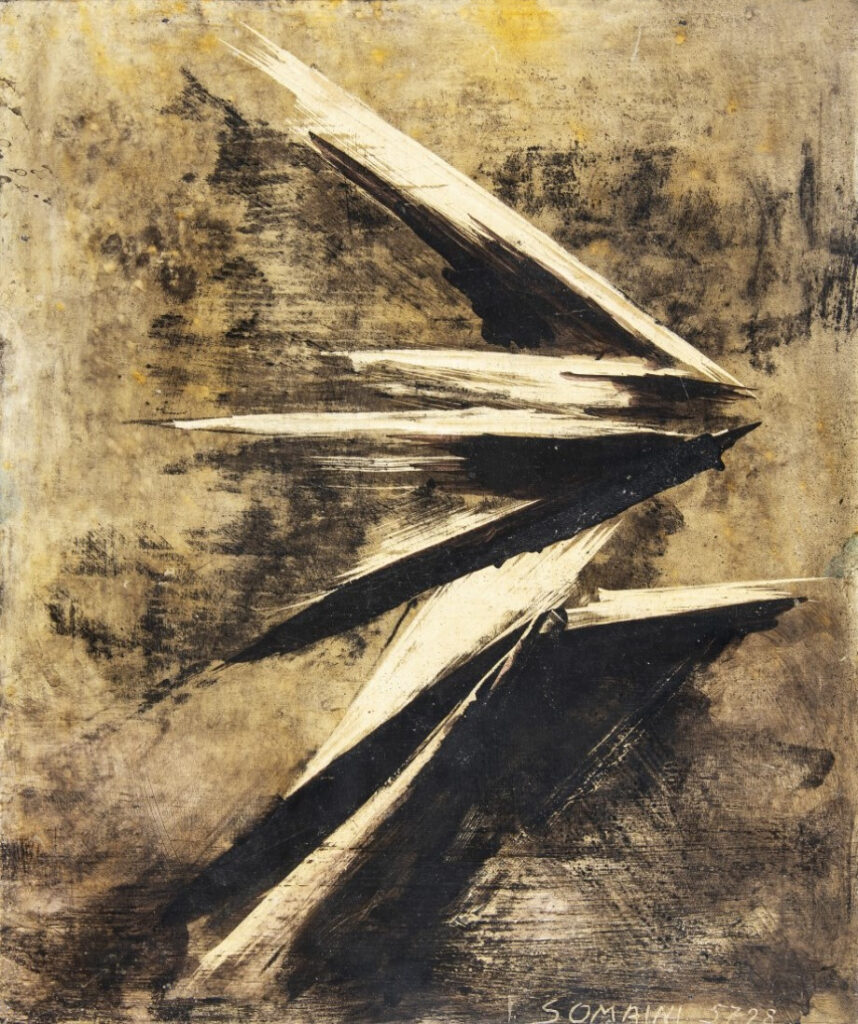
Study for a sculpture, 1957
Graffito and mixed media on wood
Pisa, Gabinetto Disegni e Stampe dell’Università di Pisa / Museo della Grafica di Palazzo Lanfranchi
(gift from Somaini to Carlo Ludovico Ragghianti for the collection of modern graphics of the University of Pisa)
“Francesco Somaini, sculptor and painter, in some studies shows a profound need to strip, to go to the essential root of things: the probing ability of an organism is accompanied by an equal capacity for synthesis, which leads his images towards the monumental calm of an architectural structure; but the development of the form, source and as it were born from a space that participates with a discovered vibration of vitality, maintains a sometimes sharp torment, which is accentuated in the drawings.”
Carlo Ludovico Ragghianti, in Mostra di 60 maestri del prossimo trentennio, catalogo della mostra (Prato, Associazione Turistica Pratese, Salone di Apollo, settembre – ottobre 1955), Tipografia Giuntina s.p.a., Firenze 1955, p. 28
Catalogue raisonné of the sculpture
The Foundation’s first important initiative is the edition of the Catalogue Raisonné of the Sculpture, edited by Skira and curated by Enrico Crispolti, the art critic and historian who has followed Somaini’s creative career since 1956, and by Luisa Somaini.
Indeed a great undertaking of cataloguing the plastic works created by the Master in over sixty years of intense research, of ordering the descriptions of the individual sculptures within chapters covering the major moments and cycles, accompanied by the most significant critical texts and poetic writings in original language, relating to each of them. Result of a monumental and minute task of cataloguing, archiving and authentication carried out by the authors, this Catalogue is currently the most complete and advanced publication on this fundamental aspect of the artist’s work. Arranged chronologically and divided according to the different operating types found over the very broad career of the artist, this book offers a new privileged point of view to fully understand his development and the extraordinary wealth of the works that have made him famous around the world as well as the great variety of cycles that comprised his practice.
Consisting in over 700 pages, it presents a recent essay by Enrico Crispolti, a detailed critical anthology and additional historical-artistic information compiled by Luisa Somaini. These texts are also published in English.
Completely illustrated in black and white with the inclusion of many images in colour, this catalogue includes over 2,500 works made between 1936 and 2001, accompanied by entries that offer succinct information also regarding publications and exhibitions. The volume is also accompanied by a large bio-bibliographic section.
Published in 2021.

Catalogue raisonné of paintings graphic chalcographic and photographic works
Catalogue raisonné of works for architecture and the urban context
The Foundation proceeds with the cataloging activity of the Master’s work, as regards the pictorial, graphic, chalcographic, photographic work and the works carried out for the architecture and the urban context (floor mosaics, stained glass windows, competitions, works of art applied and design).
Collectors and museum institutions are requested to send the catalog form entirely completed in all its parts to this office together with publishable photographs.
For information write to fondazione.somaini@gmail.com.
